
Table of Contents
- Why Nature Inspired Clothing Works for Everyday Wear
- Nature-Inspired Outfits: Four Formulas for Real Life
- Nature Graphic Tees That Do More Than One Job
- Earth-Tone Outfits: Building a Palette That Mixes Easily
- Outdoor Lifestyle Clothing: What Separates Trail-Ready From Technical
- Fabric Care, Fit, and Sizing: Getting More Wear From Each Piece
- How to Spot Genuinely Sustainable Materials
- Capsule Wardrobes and Cost-Per-Wear: Buying Less, Wearing More
- Frequently Asked Questions
Last Updated: October 20, 2026
Why Nature Inspired Clothing Works for Everyday Wear
Nature inspired clothing borrows its colors, patterns, and imagery from the outdoors, then builds it into pieces you can wear on a normal Tuesday. At Cedar Peak "Keep It Wild", we design around mountains, forests, waterfalls, rivers, and wildlife because those scenes belong on a back and not just on a wall.
The catch most guides skip: nature-inspired fashion is not one look. It splits into prints, palettes, and materials, and each behaves differently in daily wear.
Nature-Inspired Outfits: Four Formulas for Real Life
Four repeatable outfit formulas cover nearly every everyday setting, each anchored by a graphic tee or pullover. Build these once and you stop deciding what to wear.
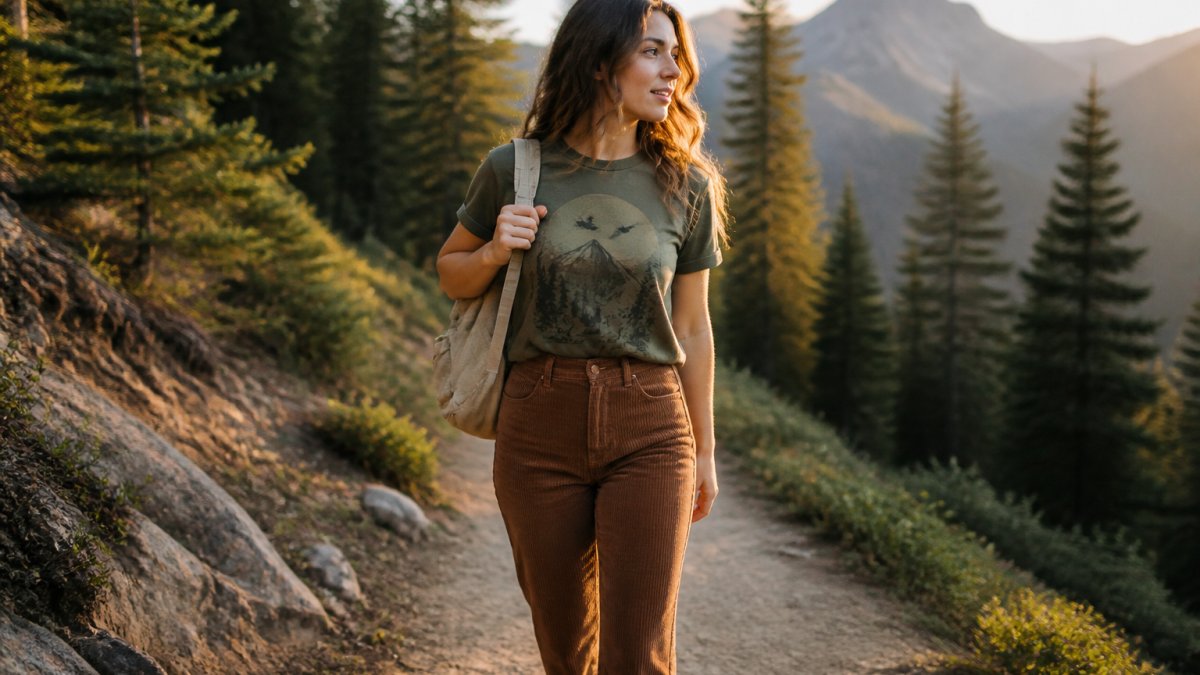
The Trail-to-Town Formula
Start with a nature graphic tee, add high-waisted pants in rust or olive, and finish with a trucker cap and a canvas bag. It reads casual in town and functional on a short hike. Our Keep It Wild rope trucker cap and Cedar camouflage bag were built for exactly this handoff.
The Weekend Casual Formula
Pair a relaxed graphic tee with jeans and a pullover tied at the waist. It is the easiest nature-inspired outfit for errands, coffee, and school pickup. The key is keeping the palette tight: one earth tone, one neutral, one print.
The Layered Camp Formula
Base layer tee, mid-layer hoodie, and a cap. Our Cedar Peak hoodie uses a cotton-poly blend with pill-resistant air jet yarn, which matters when a piece gets worn three days straight at a campsite.
The Vacation Formula
One graphic tee, one long-sleeve layer, and a backpack. Fewer pieces, more mixing. A Cedar backpack carries the day and doubles as the only bag you pack.
| Formula | Base Piece | Layer | Best For |
|---|---|---|---|
| Trail-to-Town | Graphic tee | Trucker cap | Hikes that end in town |
| Weekend Casual | Graphic tee | Tied pullover | Errands, coffee, family time |
| Layered Camp | Graphic tee | Hoodie | Cool evenings, campsites |
| Vacation | Graphic tee | Long-sleeve tee | Travel, light packing |
Nature Graphic Tees That Do More Than One Job
A nature graphic tee earns its place when the print carries the outfit and the fabric survives the wash cycle. Check two things before you buy: how the design is applied, and what the shirt is made of.
Our line art tees are built on a 4.5-ounce ring spun cotton and poly blend with a removable label and shoulder-to-shoulder taping, the detail nobody advertises and everybody feels, because it stops the neckline from stretching out after a season. Options include the Deer Line Art and Bison Line Art at $17.99, the Polar Bear Line Art at $17.99, and the Duck Line Art at $14.09.


For something with more weight, the Elk Vintage long-sleeve at $24.99 is 100% cotton at 5.4 ounces, and the Deer Vintage at $24.99 gives you the same wildlife-inspired design language in a heavier hand.
Earth-Tone Outfits: Building a Palette That Mixes Easily
Earth-tone outfits work when you limit yourself to four colors and let texture do the talking. Rust, olive, sand, and charcoal cover almost every combination and let a printed tee sit next to corduroy or canvas without clashing.
What most guides skip is that earth tones are not one family. They split into warm earths (rust, clay, ochre, terracotta), cool earths (olive, moss, slate, charcoal), and neutrals (sand, bone, taupe, ecru).
Here are four palette recipes you can build from a single graphic tee:
| Palette | Base | Second Tone | Neutral | Accent | Example Outfit |
|---|---|---|---|---|---|
| Canyon | Rust tee | Clay pants | Sand layer | Charcoal cap | Rust graphic tee, clay corduroy pants, sand long-sleeve tied at waist, charcoal trucker cap |
| Forest | Olive tee | Moss pullover | Bone pants | Rust bag | Olive graphic tee, moss hoodie, bone canvas pants, rust tote |
| River | Slate tee | Charcoal pants | Ecru layer | Olive cap | Slate line-art tee, charcoal jeans, ecru overshirt, olive cap |
| Desert | Sand tee | Ochre pants | Taupe layer | Clay bag | Sand graphic tee, ochre chinos, taupe pullover, clay canvas bag |
Texture is where earth tones stop looking flat.
Outdoor Lifestyle Clothing: What Separates Trail-Ready From Technical
Outdoor lifestyle clothing is built for the space between a trailhead and a town, not for summit day. Technical gear is engineered for weather and performance: membranes, sealed seams, articulated panels. It costs more and looks out of place at a restaurant.
The gap most guides leave open is seasonality. Fabric weight, not branding, decides whether a piece works in July or November.
Here is how we would decide:
- Will this piece be worn more than twice a week? If yes, buy lifestyle, not technical.
- Does it need to survive rain for hours? If no, skip the membrane.
- Can it pair with two things already in your closet? If not, leave it.
- Is the fabric weight right for your season? Midweight handles three seasons; heavy cotton is summer-only.
A practical layering formula for lifestyle pieces:
| Season | Mid | Outer | Example |
|---|---|---|---|
| Summer | None | None | Deer line-art tee, shorts, cap |
| Shoulder | 5.4 oz long-sleeve | Light hoodie | Bison tee, elk long-sleeve, hoodie tied at waist |
| Cool | Hoodie | Canvas overshirt | Elk long-sleeve, hoodie, canvas overshirt |
| Cold | Hoodie | Insulated vest | Elk long-sleeve, hoodie, vest, beanie |
The same logic applies to care: heavier cotton holds shape longer but shrinks more in the dryer, so air-dry the 5.4-ounce pieces and tumble the blends low.
Fabric Care, Fit, and Sizing: Getting More Wear From Each Piece
Fit and care decide how long a piece stays in rotation, and both are predictable if you check the details before ordering. Cotton-poly blends resist shrinking and hold shape better than pure cotton over repeated washes. Pure cotton feels softer but moves more in the dryer.
On sizing, our hoodie runs from XS to 5XL with a classic fit, and the size chart lists body length, body width, and sleeve length for every size. Use those numbers, not the letter on the tag. Measure a hoodie you already own that fits well, flat, and match the body width.
Care rules that actually extend life:
- Cold water, inside out, on a normal cycle
- No fabric softener on cotton blends, since it coats the fibers
- Air dry flat or hang; tumble low only if you must
- Wash graphic pieces with like colors for the first three washes
How to Spot Genuinely Sustainable Materials
Genuinely sustainable materials are the ones you can trace, not the ones described with nice adjectives. "Eco-friendly" and "green" are marketing words with no fixed meaning. Certifications and fiber content are checkable facts.
Ask three questions of any nature-inspired clothing brand:
- What is the fiber, by percentage? A label reading 60% ring spun cotton and 40% poly tells you more than any badge.
- Is there third-party verification? Look for named certification bodies, not in-house claims.
- Can they tell you where it was made? A brand that cannot answer this is not tracing its supply chain.
The FTC's Green Guides set the rules for how environmental claims can be marketed, and they are worth reading before you trust a label. For fiber-level detail, the Textile Exchange materials guidance explains what different fiber claims actually mean.
Our own position is straightforward: we publish the fiber content and construction of every piece, and we would rather you check the label than take our word for it.
Capsule Wardrobes and Cost-Per-Wear: Buying Less, Wearing More
Cost-per-wear is the price of a garment divided by the number of times you wear it. A $17.99 tee worn twice a week for two years costs pennies per wear.
A nature-inspired capsule needs about ten pieces:
- Three graphic tees in different designs
- One long-sleeve tee
- One hoodie or pullover
- Two pairs of pants in earth tones
- One cap
- One bag
- One outer layer
That set produces dozens of outfit combinations because everything shares a palette.
The Ellen MacArthur Foundation's work on circular fashion makes the same case at industry scale: the biggest environmental gain in clothing comes from wearing what exists for longer, not from buying new "sustainable" replacements.
Building a nature-inspired wardrobe that actually gets worn takes a palette that mixes, fabrics that survive washing, and a fit you can verify before checkout. At Cedar Peak "Keep It Wild", every piece starts with a wild landscape and ends with construction details we are willing to publish: ring spun cotton blends, shoulder-to-shoulder taping, pill-resistant yarn, and sizing from XS to 5XL.
Frequently Asked Questions
How do you wear nature inspired clothing every day without looking like you're heading out on a hike?
Keep one piece as the focal point and let the rest stay quiet. A nature graphic tee in a neutral earth tone pairs cleanly with plain jeans or corduroy trousers, and a single layer like the Cedar Peak Hoodie ($34.99) adds warmth without technical styling. Stick to two or three earthy colors per outfit, choose relaxed but not baggy cuts, and swap trail shoes for everyday sneakers. The result reads as casual lifestyle wear rather than gear.
What colors work well for earth-tone outfits?
Rust, olive, sand, clay, bark brown, and muted forest green form the core palette because they mix with almost anything. Add one lighter neutral such as oatmeal or stone to keep the outfit from feeling heavy. Sunset-inspired shades like burnt orange work best as accents on a tee or cap rather than full outfits. If you build around three of these colors, most pieces in your closet will combine without effort.
Can nature-inspired clothes be comfortable enough for hiking and daily wear?
Yes, provided the fabric suits both settings. Ring-spun cotton blends, like those used in the Cedar Peak line art tees ($17.99), stay soft against the skin and hold their shape through repeated washing. For cooler days, the 50/50 cotton-poly Cedar Peak Hoodie ($34.99) resists pilling and keeps its stretch. These pieces handle a day trail and a coffee run equally well, though for sustained rain or heavy backcountry use you would still want dedicated technical shells.
How do I know a brand's sustainability claims are real rather than marketing?
Ask for specifics rather than slogans. Look for named fiber content such as organic cotton or recycled polyester, information about where garments are manufactured, and third-party certifications where they apply. Vague phrases like eco-friendly mean little without a standard behind them. Cedar Peak lists exact fabric compositions for each product, including the 100% cotton Elk Vintage long sleeve ($24.99), which lets you judge materials directly instead of relying on claims.
Will the prints on nature graphic tees fade or crack after washing?
Print longevity depends mostly on care. Wash graphic tees inside out in cold water, skip the dryer or use low heat, and avoid ironing directly over the design. Cotton-blend tees like the Deer Line Art and Bison Line Art ($17.99 each) tolerate regular washing well when treated this way. Following the care label and rotating tees between wears extends print life considerably compared with hot washes and high-heat drying.